Cylinders are fundamental three-dimensional geometric solids widely encountered in both theoretical mathematics and everyday applications. Characterized by two parallel, congruent circular bases connected by a smooth, curved surface, they appear in various forms all around us. Common real-world examples of cylinders include pipes, storage barrels, and batteries. Understanding their geometric properties, capacity limits, and external dimensions is crucial for engineering, construction, and manufacturing.
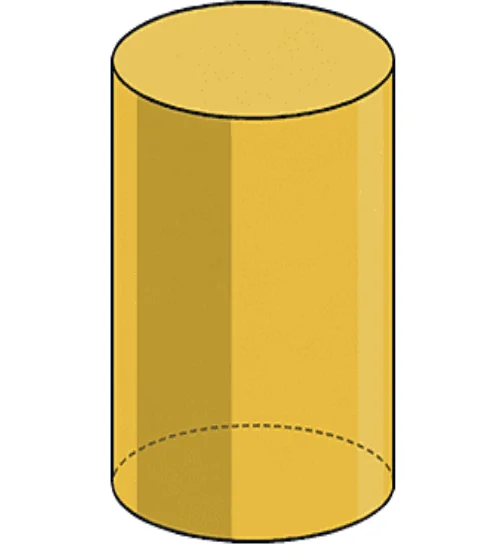
Standard Cylinder Formulas: Volume and Surface Area
To analyze a standard cylinder, we evaluate two primary measurements: its internal holding capacity and its exterior boundary footprint.
Volume of a Cylinder
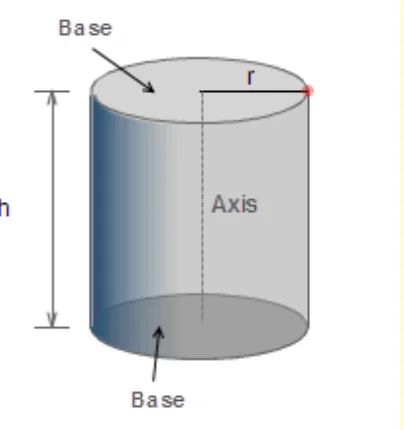
The volume of a cylinder represents its total internal capacity, quantifying how much material it can hold. Mathematically, it is calculated as:
- Volume (V) = Area of base (A) × Height (h) = πr²h cubic units
Here, 'r' denotes the radius of the circular base, and 'h' signifies the vertical height of the cylinder.
Total Surface Area of a Cylinder
The total external space covered by the solid includes the curved side and both circular end caps:
- Total Surface Area = Curved surface area + Area of both circular bases = 2πrh + 2πr² = 2πr(h + r) square units.
Properties and Formulas of a Hollow Cylinder
A hollow cylinder is defined as a cylindrical shell with a vacant center. It features an internal radius and an external radius, where the thickness of the structure is determined by the difference between them: (R - r).
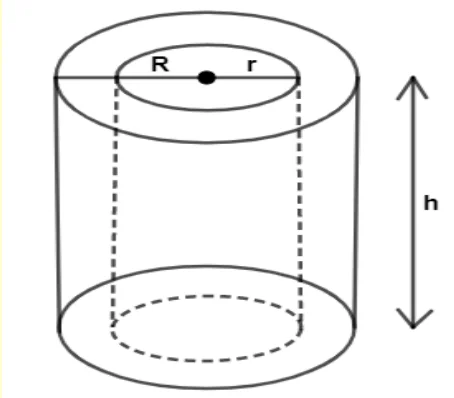
The calculation guidelines for hollow configurations differ to account for the inner void:
- Volume of a hollow cylinder (V) = π(R² - r²)h cubic units.
- Surface area of a hollow cylinder = Curved surface area + Area of both annular bases = 2πh(R + r) + 2π(R² - r²) square units.
Solved Practical Problems
Applying these geometric principles helps solve real-world calculation tasks:
Problem 1: Cylindrical Water Tank Capacity
A cylindrical water tank has a radius of 25 inches and a height of 120 inches. Using π = 3.14, its volume is calculated as 235,500 cubic inches.
Problem 2: Finding Base Radius from Volume
A cylindrical container with a volume of 440 cm³ and a height of 35 cm (using π = 22/7) results in a base radius of 2 cm.
Problem 3: Painting a Cylindrical Pillar
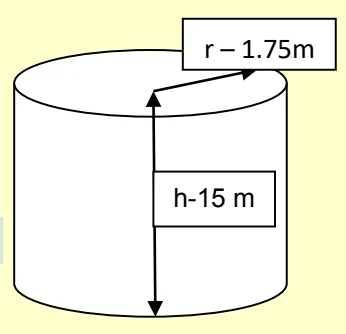
A cylindrical pillar 15 m high with a base diameter of 350 cm is painted at the rate of Rs 25 per m². Based on a curved surface area of 165 m², the total painting cost comes to Rs. 4,125.
Problem 4: Material Volume of a Drainage Tile
A cylindrical drainage tile that is 21 cm long with inner and outer diameters of 4.5 cm and 5.1 cm respectively requires a volume of clay equal to 30.24π cm³.
Problem 5: Determining Cylinder Height
A solid cylinder with a 5 cm radius and a total surface area of 660 cm² has a calculated height of 16 cm.
Problem 6: Wetted Surface Area of a Tank
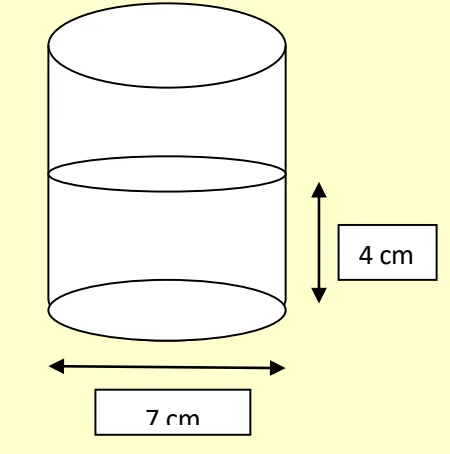
A cylindrical tank with a 7 m diameter and a water depth of 4 m yields a total wetted surface area of 126.5 m².
Frequently Asked Questions (FAQs)
Recommended Reads
- AP AEE Answer Key 2026 Released: Download Official Response Sheet and Raise Objections
- DSSSB MTS Result 2026 Declared: Check Shortlist, Cut-Offs & E-Dossier Details
- Bihar Librarian Syllabus 2026: Exam Pattern, Topics, and Preparation Guide
- SSC CHSL 2026 Notification: Major Exam Changes & Application Updates
- APCOB Recruitment 2026: Admit Card Download Guide, Exam Schedule & Essential Tips
- BGSSL Recruitment 2026: Apply for 2049 Executive & Managerial Roles | Bank of Baroda Subsidiary
Exam Photo & Signature Resizer (20KB - 50KB)
Resize passport photo & signature to 20-50KB with Name & Date of Photo (DOP) strip or combine them in 1-click.
Never miss another exam update!
Get the fastest exam results, recruitment news, and educational guides delivered directly to your phone.