The Tamil Nadu Public Service Commission (TNPSC) has announced the schedule for the Group 1 Combined Civil Services Examination-I (Group-1 Services) 2026. This highly sought-after examination offers a pathway to prestigious government positions within Tamil Nadu, with 46 vacancies available for the upcoming cycle. Aspiring candidates must familiarize themselves with the crucial details including examination dates, eligibility criteria, the application procedure, examination pattern, syllabus, and salary structure. This article serves as a comprehensive resource, providing all the necessary information to navigate the TNPSC Group 1 recruitment process successfully.
The official TNPSC Group 1 Notification PDF (Advt No. 736) was released on 23rd June 2026, marking the commencement of the application window. This recruitment drive is crucial for filling key administrative roles across various departments in the state.
Key Dates and Application Timeline
Prospective candidates should note the important dates for the TNPSC Group 1 Examination 2026:
| Activity | Dates |
|---|---|
| TNPSC Group 1 Notification 2026 | 23rd June 2026 |
| TNPSC Group 1 Apply Online 2026 | 30th June 2026 |
| Last Date to Apply Online | 29th July 2026 (11:59 pm) |
| Last Date to Pay the Application Fee | 29th July 2026 |
| Modification Window | 2nd to 4th August 2026 |
| TNPSC Group 1 Hall Ticket 2026 | September 2026 |
| TNPSC Group 1 Exam Date 2026 (Prelims) | 27th September 2026 |
| TNPSC Group 1 Answer Key | September 2026 |
| TNPSC Group 1 Result | October/November 2026 |
| TNPSC Group 1 Mains | To be notified |
Understanding the Vacancies and Posts
A total of 46 vacancies have been announced for the TNPSC Group 1 Services 2026. This year, there have been some significant changes in the post distribution. Notably, Deputy Superintendent of Police (DSP), Assistant Director of Rural Development, and District Employment Officer posts have been removed. In their place, new positions such as Deputy Registrar of Co-operative Societies and District Registrar have been added.
| Post Name | Vacancies | Name of Service |
|---|---|---|
| Deputy Collector | 12 | Tamil Nadu Civil Service |
| Assistant Commissioner (Commercial Taxes) | 02 | Tamil Nadu Commercial Taxes Service |
| Deputy Registrar of Co-operative Societies | 03 | Tamil Nadu Co-operative Service |
| District Registrar | 08 | Tamil Nadu Registration Service |
| Assistant Commissioner of Labour | 01 | Tamil Nadu Labour Service |
| Additional Vacancies | 20 | |
| Total | 46 |
Eligibility Criteria: Age and Education
To be eligible for the TNPSC Group 1 Examination 2026, candidates must meet specific age and educational qualifications. A degree from a recognized university is the fundamental requirement. Final-year degree students can apply for the preliminary exam, provided they furnish proof of passing during the original document upload stage for the Main Written Examination.
Age Limit (as on 01/07/2026)
The minimum age for all posts is 21 years. The maximum age limits vary:
| Post Name | Minimum Age | UR | SCs, SC(A)s, STs, MBCs/DCs, BC(OBCM)s, BCMs and Destitute Widow | Persons with Benchmark Disability | Ex-Service men |
|---|---|---|---|---|---|
| All posts excluding Assistant Commissioner (Commercial Taxes) | 21 years | 34 years | 39 years | 44 years | 50 years |
| Assistant Commissioner (Commercial Taxes) - Any Degree | 21 years | 35 years | 39 years | 44 years | 50 years |
| Assistant Commissioner (Commercial Taxes) - B.L. Degree | 21 years | 34 years | 40 years | 45 years | 50 years |
Educational Qualification Details
| Educational Qualification |
|---|
| Deputy Collector Candidates must have completed a degree from any of the Universities incorporated by an Act of the Central or State Legislature in India, or other Educational institutions. |
| Deputy Registrar of Co-operative Societies Candidates must possess a degree from any of the Universities incorporated by an Act of the Central or State Legislature in India, or Other Educational Institution. |
| Assistant Commissioner (Commercial Taxes) Candidates must possess a degree from any of the Universities or boards. Preference will be given in the following order:
|
| District Registrar Candidates must possess a degree from any of the Universities incorporated by an Act of the Central or State Legislature in India or Other Educational Institution. |
| Assistant Commissioner of Labour Degree from any of the Universities or boards. Preference shall be given to freedom fighters and members of their families. |
Physical Standards
Specific physical qualifications are required for the Deputy Superintendent of Police (Category I) post:
| Name of the Posts | Physical Qualification |
|---|---|
| Deputy Superintendent of Police (Category I) | For Men: Must be not less than 165 cms in height and not less than 86 cms round the chest on full inspiration and must have a chest expansion of not less than 5 cms on full inspiration. For Women: Must be not less than 155 cms in Height. The Chest measurement will not apply to them. |
Application Process and Fees
The application process for the TNPSC Group 1 Examination 2026 is conducted entirely online. Candidates must register themselves on the TNPSC One-Time Registration (OTR) portal, which is valid for five years.
How to Apply for TNPSC Group 1 2026
- Visit the official TNPSC website.
- Navigate to the 'Recruitment' or 'Notifications' section.
- Find the link for the TNPSC Group 1 Combined Civil Services Examination–I (Group-1 Services) 2026.
- Click on the 'Apply Online' link.
- If you are a new user, complete the One-Time Registration (OTR) process. If you are already registered, log in using your credentials.
- Fill in the application form with accurate personal, educational, and contact details.
- Upload scanned copies of your photograph and signature as per the specifications mentioned in the notification.
- Pay the required application fees through the online payment gateway.
- Review all the details entered in the application form before final submission.
- Download and save the submitted application form for future reference.
Application Fee Structure
The fee structure for the TNPSC Group 1 Examination 2026 is as follows:
| Particulars | Fee |
|---|---|
| One-time Registration Fee | Rs. 150/- (valid for 5 years) |
| Examination Fee (Prelims) | Rs. 100/- |
| Main Written Examination Fee | Rs. 200/- |
| SC/ SC (Arunthathiyars)/ ST/ PwBD/ Destitute Widow | No fee |
| MBC/ Denotified Communities/ BC (Other than Muslim)/ BC (Muslim) | 3 free chances |
| Ex-Servicemen | 2 free chances |
Candidates already registered in the One-Time Registration system within the 5-year validity period are exempted from paying the registration fee again.
Changes in TNPSC Group 1 2026 Exam
- Posts Removed: Deputy Superintendent of Police (DSP), Assistant Director of Rural Development, District Employment Officer
- Post Additions: Deputy Registrar of Co-operative Societies and District Registrar
- Reduced Preliminary Centres: Pollachi, Attur, Thuraiyur, Thirumangalam, Cheranmahadevi, and Tindivanam have been removed as preliminary exam centres.
TNPSC Group 1 Exam Pattern and Syllabus
The TNPSC Group 1 selection process is a three-tiered system comprising the Preliminary Examination, Main Written Examination, and an Interview. Marks obtained in the Prelims are not counted for the final merit list but are used for shortlisting candidates for the Mains.
Preliminary Examination Pattern
| Subject | Number of Questions | Total Marks | Duration of Exam |
|---|---|---|---|
| General Studies (Degree Standard) | 175 | 300 | 3 hours |
| Aptitude & Mental Ability Test (SSLC Standard) | 25 | ||
| Total | 200 | 300 |
Each question in the Prelims exam carries 1.5 marks. There is no negative marking. The minimum qualifying marks for the Prelims are 90/300 for SCs, SC(A)s, STs, MBCs/DCs, BC(OBCM)s, and BCMs, and 120/300 for others.
Candidates can find detailed syllabus information on the TNPSC Group 1 Syllabus 2026 for Prelims + Mains.
Main Written Examination Pattern
| Subjects | Total Marks | Duration of Exam |
|---|---|---|
| Paper-I Tamil Eligibility Test (SSLC Standard) (Descriptive Type) | 100 | 3 hours |
| General Studies (Degree Standard) | ||
| Paper II | 250 | 3 hours |
| Paper III | 250 | 3 hours |
| Paper IV | 250 | 3 hours |
| Interview & Records | 100 | |
| Total | 850 |
Paper-I of the Main exam is qualifying in nature. Marks from Papers II, III, and IV, along with the interview, are considered for the final merit list. Approximately 20 times the number of vacancies will be invited for the Main examination based on Prelims performance.
Candidates are encouraged to practice with TNPSC Group 1 Previous Year Question Papers to understand the exam's difficulty and pattern.
Salary and Career Prospects
Successful candidates appointed to TNPSC Group 1 services will be placed in Pay Level 12, with a monthly salary ranging from Rs. 56,100 to Rs. 205,700. This attractive pay scale, along with the opportunity for career advancement and public service, makes these positions highly desirable.
For a detailed breakdown of the salary structure, refer to the TNPSC Group 1 Salary Structure.
TNPSC Group 1 Prelims Exam Centres
The Prelims exam will be conducted in various centres across Tamil Nadu. Candidates must select their preferred exam centre during the application process. Please note that some centres have been removed for the 2026 exam.
| City Code | Exam Centre | City Code | Exam Centre |
|---|---|---|---|
| 3001 | Ariyalur | 1601 | Ramanathapuram |
| 3301 | Chengalpattu | 3501 | Ranipet |
| 0101 | Chennai | 1701 | Salem |
| 0201 | Coimbatore | 1805 | Karaikudi |
| 0303 | Chidambaram | 3601 | Tenkasi |
| 0401 | Dharmapuri | 1901 | Thanjavur |
| 0501 | Dindigul | 1301 | The Nilgiris |
| 0601 | Erode | 2001 | Theni |
| 3401 | Kallakurichi | 2101 | Thiruvallur |
| 0701 | Kancheepuram | 2201 | Thiruvannamalai |
| 0801 | Nagercoil | 2301 | Thiruvarur |
| 0901 | Karur | 2401 | Thoothukudi |
| 3101 | Krishnagiri | 2501 | Tiruchirappalli |
| 1001 | Madurai | 2601 | Tirunelveli |
| 3801 | Mayiladuthurai | 3701 | Tirupathur |
| 1101 | Nagapattinam | 3201 | Tiruppur |
| 1201 | Namakkal | 2701 | Vellore |
| 1401 | Perambalur | 2801 | Villupuram |
| 1501 | Pudukkottai | 2901 | Virudhunagar |
Post-Examination Procedures
Following the Preliminary Examination, the TNPSC will release the Answer Key, typically in September 2026. Candidates can use this to estimate their scores. The results for the Prelims are expected in October/November 2026. Those who qualify will then be eligible to apply for and appear in the Main Written Examination. The Hall Ticket for the Prelims exam is anticipated in September 2026, and candidates should download it well in advance of the exam date.
For updates on hall tickets and previous year trends, visit TNPSC Group 1 Hall Ticket 2026 and TNPSC Group 1 Cut Off (Previous Year).
General Information
The official website of the Tamil Nadu Public Service Commission (TNPSC) is www.tnpsc.gov.in. Candidates are advised to regularly check the website for any further notifications or updates regarding the Group 1 examination.
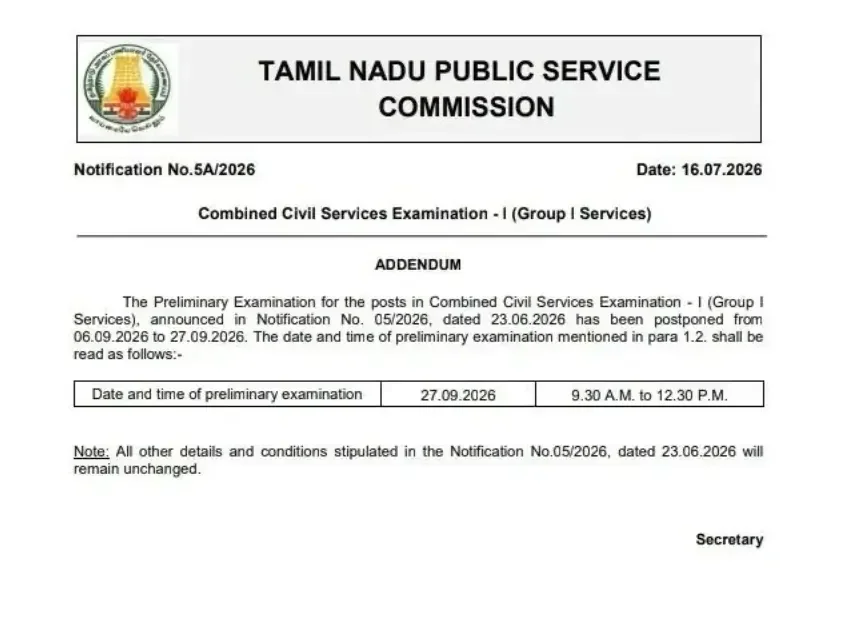
For comprehensive details, always refer to the official notification and the TNPSC website.
Frequently Asked Questions (FAQs)
Recommended Reads
- TNPSC Group 1 Salary Structure, Allowances, Perks & Job Profile 2026
- TNPSC Group 1 & Group 1A Notification 2025: Check Vacancies, Dates & Eligibility
- TNPSC Group 1 Recruitment 2026: Apply Online for 26 Vacancies, Dates, Fee
- TNPSC Group 1 Cut Off Marks: Historical Trends (2014-2022) & 2026 Preparation Guide
- TNPSC Group 1 Hall Ticket 2026: Prelims Exam Date & Download Guide
- TNPSC Group 1 Final Result 2026 Declared: Check Merit List and 72 Vacancies
- TNPSC Group 1 Syllabus and Exam Pattern 2026: Complete Guide
Negative Marking & Net Score Calculator
Calculate your exact post-answer-key net marks after deducting 1/3rd or 1/4th negative penalty across SSC, UPSC, and State exams.
Never miss another exam update!
Get the fastest exam results, recruitment news, and educational guides delivered directly to your phone.