Welcome to our comprehensive educational guide on mathematics numbers. Understanding how integers behave forms the foundation of number theory. When studying numbers, concepts branch into areas like Rational numbers, prime numbers, and composite numbers. In this detailed tutorial, we will explore everything you need to know about composite numbers, their key attributes, listings, and core mathematical principles.
What is a Composite Number?
Composite numbers are defined as positive integers that have more than two distinct factors (divisible by at least one number other than 1 and the number itself). To truly grasp this, it helps to contrast it against a prime number, which has exactly two factors (1 and the number itself).
An important fundamental rule to remember is that the number 1 is neither prime nor composite because it has only one factor. Every composite number can be written as a product of two or more prime numbers.
Properties of Composite Numbers
To help you master this mathematical concept, review the core checklist outlining the traits of composite numbers:
- Composite numbers are evenly divisible by smaller numbers that can be prime or composite.
- Composite numbers have more than two factors.
- Each composite number is a factor of its magnitude.
- Composite numbers are divisible by other composite numbers.
- Each composite number has at least two prime numbers as factors.
Important Points and Classifications
When exploring numbers, separating them by whether they are an even number or an odd number reveals special patterns:
- All even numbers other than 2 are composite numbers.
- 4 is the smallest composite number.
- 10 is the smallest two-digit composite number.
- 9 is the smallest odd composite number.
- 100 is the smallest and 999 is the largest three-digit composite number.
- Each composite number can be written as a product of two or more prime numbers.
Additionally, 4 is the smallest even number designated as composite, and 9 is recognized as the smallest two-digit odd composite number.
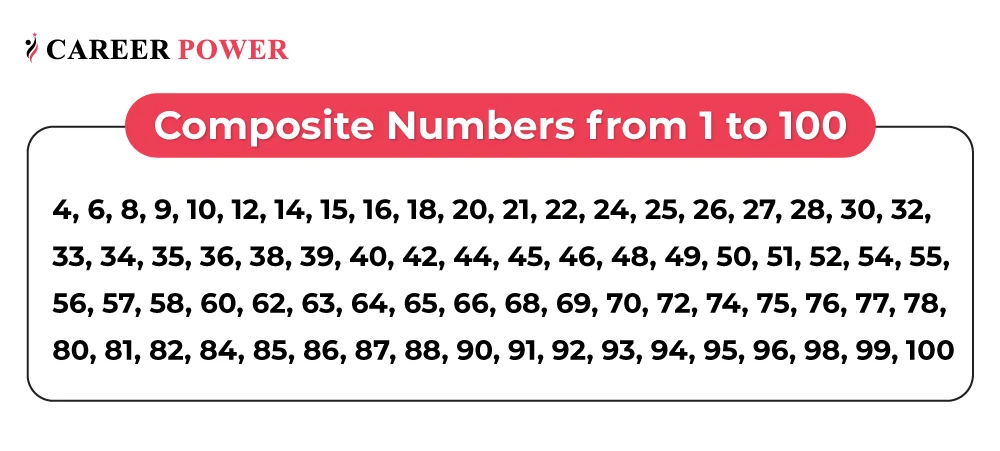
Composite Numbers from 1 to 100
There are exactly 74 composite numbers between 1 and 100. Below is the complete data table outlining these numbers for your reference:
| Composite Numbers from 1 to 100 |
|---|
| 4, 6, 8, 9, 10, 12, 14, 15, 16, 18, 20, 21, 22, 24, 25 |
| 26, 27, 28, 30, 32, 33, 34, 35, 36, 38, 39, 40, 42, 44, 45 |
| 46, 48, 49, 50, 51, 52, 54, 55, 56, 57, 58, 60, 62, 63, 64 |
| 65, 77, 68, 69, 70, 72, 74, 75, 76, 77, 78, 80, 81, 82, 84 |
| 85, 86, 87, 88, 90, 91, 92, 93, 94, 95, 96, 98, 99, 100 |
Solved Examples and Prime Factorizations
Let's look at some examples of even numbers and odd numbers to understand their factorizations:
- The prime factorization of 42 is 2 x 3 x 7, and 42 is divisible by eight different numbers.
- The prime factorization of 55 is 5 and 11.
- By contrast, numbers like 53 and 211 are prime numbers, not composite numbers.
- The product of the first 4 composite numbers (4, 6, 8, and 9) equals 1,728.
Frequently Asked Questions (FAQs)
Recommended Reads
- AP AEE Answer Key 2026 Released: Download Official Response Sheet and Raise Objections
- DSSSB MTS Result 2026 Declared: Check Shortlist, Cut-Offs & E-Dossier Details
- Bihar Librarian Syllabus 2026: Exam Pattern, Topics, and Preparation Guide
- SSC CHSL 2026 Notification: Major Exam Changes & Application Updates
- APCOB Recruitment 2026: Admit Card Download Guide, Exam Schedule & Essential Tips
- BGSSL Recruitment 2026: Apply for 2049 Executive & Managerial Roles | Bank of Baroda Subsidiary
Exam Photo & Signature Resizer (20KB - 50KB)
Resize passport photo & signature to 20-50KB with Name & Date of Photo (DOP) strip or combine them in 1-click.
Never miss another exam update!
Get the fastest exam results, recruitment news, and educational guides delivered directly to your phone.