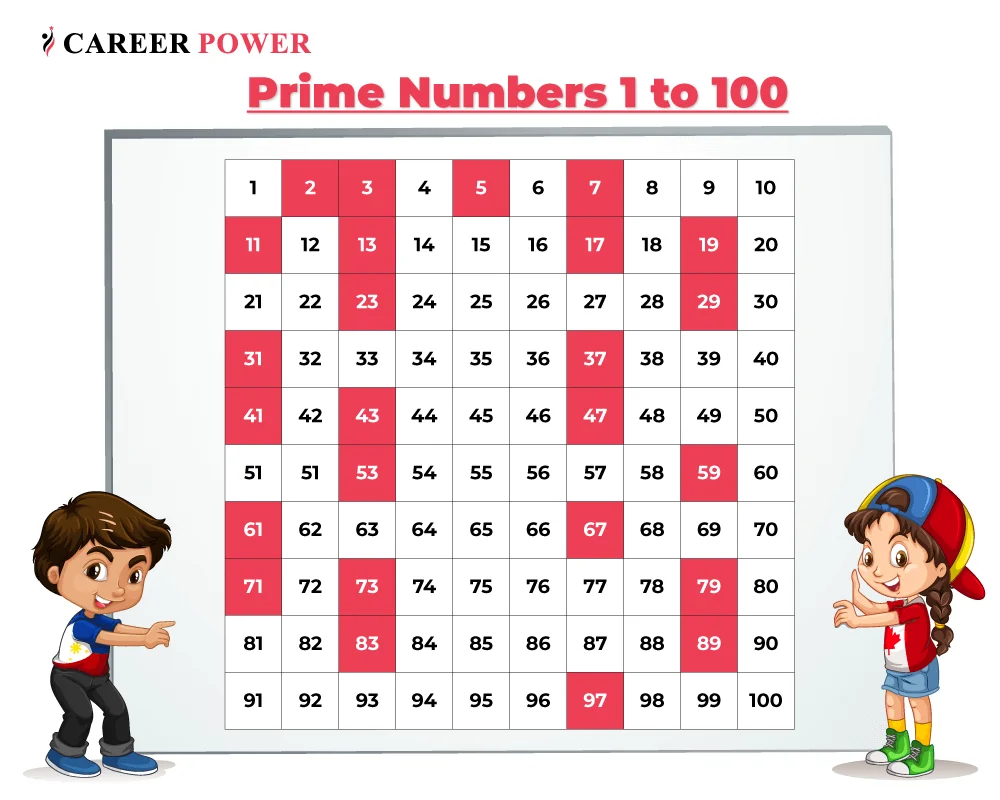
What are Prime Numbers? A prime number is a natural number greater than 1 that cannot be formed by multiplying two smaller natural numbers. In other words, a prime number is divisible only by 1 and itself. If 'p' is a prime number, its only positive factors are 1 and 'p'.
Prime Number Definition
Prime Number Definition: A prime number is a natural number greater than 1 that has exactly two distinct positive divisors: 1 and itself. Common examples include 5, 7, 19, and 23. In Hindi, a Prime Number is known as रूढ़ या अभाज्य संख्या.
The first 10 prime numbers are: 2, 3, 5, 7, 11, 13, 17, 19, 23, and 29.
The first 20 prime numbers are: 2, 3, 5, 7, 11, 13, 17, 19, 23, 29, 31, 37, 41, 43, 47, 53, 59, 61, 67, and 71.
Note: The number 1 is neither prime nor composite, as it has only one factor.
Prime Numbers List
In addition to the definition, we provide a complete list of prime numbers from 1 to 100 and 1 to 1000. There are 25 prime numbers between 1 and 100, and 168 prime numbers between 1 and 1000.
Prime Numbers from 1 to 100
There are 25 prime numbers between 1 and 100. The full list of prime numbers from 1 to 100 is: 2, 3, 5, 7, 11, 13, 17, 19, 23, 29, 31, 37, 41, 43, 47, 53, 59, 61, 67, 71, 73, 79, 83, 89, and 97.
| Prime Numbers from 1 to 100 |
|---|
| 2, 3, 5, 7, 11, 13, 17, 19, 23, 29, 31, 37, 41, 43, 47, 53, 59, 61, 67, 71, 73, 79, 83, 89 and 97. |
| Prime Numbers from 1 to 100 | |
|---|---|
| List of Numbers | Prime Numbers |
| Between 1 and 10 | 2, 3, 5, 7 |
| Between 11 and 20 | 11, 13, 17, 19 |
| Between 21 and 30 | 23, 29 |
| Between 31 and 40 | 31, 37 |
| Between 41 and 50 | 41, 43, 47 |
| Between 51 and 100 | 53, 59, 61, 67, 71, 73, 79, 83, 89, 97 |
Prime Numbers 1 to 100 Chart

Prime Numbers from 1 to 1000
There are exactly 168 prime numbers between 1 and 1000, including: 2, 3, 5, 7, 11, 13, 17, 19, 23, 29, 31, 37, 41, 43, 47, 53, 59, 61, 67, 71, 73, 79, 83, 89, 97, 101, 103, 107, 109, 113, 127, 131, 137, 139, 149, 151, 157, 163, 167, 173, 179, 181, 191, 193, 197, 199, 211, 223, 227, 229, 233, 239, 241, 251, 257, 263, 269, 271, 277, 281, 283, 293, 307, 311, 313, 317, 331, 337, 347, 349, 353, 359, 367, 373, 379, 383, 389, 397, 401, 409, 419, 421, 431, 433, 439, 443, 449, 457, 461, 463, 467, 479, 487, 491, 499, 503, 509, 521, 523, 541, 547, 557, 563, 569, 571, 577, 587, 593, 599, 601, 607, 613, 617, 619, 631, 641, 643, 647, 653, 659, 661, 673, 677, 683, 691, 701, 709, 719, 727, 733, 739, 743, 751, 757, 761, 769, 773, 787, 797, 809, 811, 821, 823, 827, 829, 839, 853, 857, 859, 863, 877, 881, 883, 887, 907, 911, 919, 929, 937, 941, 947, 953, 967, 971, 977, 983, 991, and 997.
Properties of Prime Numbers
Key properties and characteristics of prime numbers include:
- A prime number is a whole number greater than 1.
- It has exactly two factors i.e., 1 and the number itself.
- There is only one even prime number i.e. 2.
- Except 2, all other prime numbers are odd. In other words, we can say that 2 is the only even prime number.
- Any two prime numbers are always co-prime to each other.
- Every number can be expressed as the product of prime numbers.
- The prime numbers 2 and 3 are the only two natural numbers that are prime in consecutive order.
Terms Related to Prime Numbers
Let's explore important terms and classifications related to prime numbers.
Twin Prime Numbers
Twin prime numbers are pairs of primes that have a difference of 2. Examples include (3, 5), (5, 7), and (11, 13). The pair (2, 3) is not a twin prime because their difference is 1. The first ten twin prime pairs are (3, 5), (5, 7), (11, 13), (17, 19), (29, 31), (41, 43), (59, 61), (71, 73), (101, 103), (107, 109), and (137, 139).
Smallest Prime Number
2 is the smallest prime number. Since 1 is not considered a prime number by definition, 2 holds the title of the smallest prime.
Largest Prime Number
The largest known prime number, as of 2018, is 2^(82,589,933) – 1, containing over 24 million digits, discovered by the Great Internet Mersenne Prime Search (GIMPS).
Even Prime Number
2 is the only even prime number. All other prime numbers are odd.
Twist Prime Number
Twist prime numbers (also known as emirp numbers) are prime numbers that result in a different prime number when their digits are reversed. Examples include (13, 31) and (17, 71).
How to check a prime number?
To determine if a number is prime, you can utilize the prime factorization method.
Steps to check if a number is prime:
- Step 1: Find out the factors for the given number.
- Step 2: Count the number of factors for that number.
- Step 3: Hence, if there are more than 2 factors, it is a composite number. Otherwise, It is a prime number.
How to find prime numbers?
The following methods will help you identify whether a specific number is prime.
- Tests of Divisibility
- Factorization
Method 1: Tests of Divisibility
Follow these logical steps to verify if any number is a prime number:
Step 1: Check the last digit. If it ends in 0, 2, 4, 6, or 8, the number is composite (except for 2).
Step 2: Add the digits of the number. If the sum is divisible by 3, the number is likely not prime.
Step 3: Calculate the square root of the number to narrow down the potential factors.
Step 4: Divide the original number by all prime numbers less than its square root.
Note: Any number ending in 5 (greater than 5) is divisible by 5 and therefore not prime.
Method 2: Factorization
Factorization is the standard method for identifying prime status. Here is how to use it:
Step 1: Identify all factors of the given number.
Step 2: Count the total number of factors.
Step 3: If the count of factors is more than two, the number is composite.
Prime Numbers and Co-prime Numbers
There is a clear distinction between prime numbers and co-prime numbers. Co-primes are defined in pairs where their greatest common factor (GCF) is 1. Co-prime numbers do not have to be prime numbers themselves.
Examples of co-prime numbers:
5 and 9 are co-prime.
6 and 11 are co-prime.
18 and 35 are co-prime.
Note: Co-prime numbers do not necessarily have to be prime.
Prime Numbers and Composite Numbers
A prime number has exactly two factors, while a composite number has more than two factors. Learn more about the differences between prime and Composite Numbers.
| Prime Numbers | Composite Numbers |
| Numbers, greater than 1, have only two factors, 1 and the number itself. | Numbers, greater than 1 have at least three factors. |
| 2 is the smallest and the only even prime number. | 4 is the smallest composite number. |
| Examples of prime numbers are 2, 3, 5, 7, 11, 13, etc. | Examples of composite numbers are 4, 6, 8, 9, 10, etc. |
Prime Numbers Related Questions
Q1: What is the prime factorization of 23?
Answer: Since 23 is prime, its only factors are 1 and 23.
Q2: Identify which of these are prime numbers: 78, 45, 61, 29, 93, 9.5, 64, 42.
Values provided: 78, 45, 61, 29, 93, 9.5, 64, 42.
Answer: A prime number must have exactly two factors.
78 has factors: 1, 2, 3, 6, 13, 26, 39, and 78 (Composite).
45 has factors: 1, 3, 5, 9, 15, and 45 (Composite).
61 has factors: 1 and 61 (Prime).
29 has factors: 1 and 29 (Prime).
93 has factors: 1, 3, 31, and 93 (Composite).
9.5 is a decimal and not a natural number (Not Prime).
64 has many factors: 1, 2, 4, 8, 16, 32, 64 (Composite).
42 has factors: 1, 2, 3, 6, 7, 14, 21, and 42 (Composite).
Result: 61 and 29 are the only prime numbers in the list.
Q3: Is 17 a prime number?
Answer: Yes, 17 is prime as it has only two factors: 1 and 17.
Q4: What is the general formula for finding prime numbers?
Answer: All prime numbers greater than 3 can be expressed in the form:
6n ± 1
You can test if a number is prime by seeing if it fits the 6n + 1 or 6n - 1 pattern.
For example, if n = 1:
6(1) - 1 = 5
6(1) + 1 = 7
For n = 2:
6(2) - 1 = 11
6(2) + 1 = 13
This formula is a useful tool for identifying candidates, expressed as 6n ± 1.
Q5: Check if 83 and 88 are prime.
Answer: Using factorization:
83 has factors 1 and 83 (Prime).
88 has factors 1, 2, 4, 8, 11, 22, 44, and 88 (Composite).
A prime number strictly requires only two factors.
Conclusion: 83 is prime; 88 is composite.
Q6: Smallest prime between 10 and 20?
Answer: Primes between 10 and 20 are 11, 13, 17, and 19. The smallest is 11.
Q7: What is the largest 3-digit prime number?
Answer: Starting from the largest 3-digit number, 999:
999 factors: 1, 3, 9, 27, 37, 111, 333, 999 (Composite).
999 is not prime.
998 factors: 1, 2, 499, 998 (Composite).
998 is not prime.
Next is 997.
997 has only 1 and 997 as factors.
Answer: 997 is the largest 3-digit prime.
Q8: Sum of the first five primes divided by 4?
Answer: First five primes: 2, 3, 5, 7, 11.
Sum:
2 + 3 + 5 + 7 + 11 = 28.
28 divided by 4:
28 / 4 = 7.
Answer: The result is 7.
Q9: List all prime numbers less than 60.
Answer: 2, 3, 5, 7, 11, 13, 17, 19, 23, 29, 31, 37, 41, 43, 47, 53, and 59.
Q10: How many prime numbers are there between 90 and 100?
Answer: 97 is the only prime between 90 and 100.
Prime Numbers- FAQs
A prime number has only two factors (1 and itself), whereas a composite number has more than two factors.
The easiest way to check if 'p' is prime is to verify that its only factors are 1 and 'p'.
No, 1 is neither prime nor composite because it has only one factor.
A prime number has two factors (1 and itself). Co-prime numbers are pairs of numbers with a greatest common factor of 1.
2 is the smallest prime number.
There are 25 prime numbers between 1 and 100.
No, prime numbers must be natural numbers (positive integers).
Yes, 2 is the only even prime number.
No, 91 is composite; its factors are 1, 7, 13, and 91.
The first five prime numbers are 2, 3, 5, 7, and 11.
The primes from 1 to 200 are: 2, 3, 5, 7, 11, 13, 17, 19, 23, 29, 31, 37, 41, 43, 47, 53, 59, 61, 67, 71, 73, 79, 83, 89, 97, 101, 103, 107, 109, 113, 127, 131, 137, 139, 149, 151, 157, 163, 167, 173, 179, 181, 191, 193, 197, and 199.
Yes, 23 is a prime number.
Yes, 29 is a prime number.
2 is the smallest and the only even prime number.
Also Read:
- What are Co-Prime Numbers? Definition, Examples, and Properties (1 to 100)
- Prime Minister Internship Scheme 2026: Registration, Eligibility, and Application Guide
- Test Prime: All-In-One Mock Test Subscription for Govt Exams
- Full List of Prime Ministers of India (1947–2026): Timeline & Key Facts
- JK Police SI Recruitment 2024: Apply Online for 669 Sub-Inspector Vacancies
- CAT Eligibility 2024: Complete Guide to Age Limit and Qualifications