The UGC NET exam is the gateway for candidates aspiring to qualify for Assistant Professor roles or Junior Research Fellowship (JRF) positions in prestigious Indian universities and colleges. The UGC NET syllabus is structured into two parts: Paper 1, which is mandatory for all aspirants, and Paper 2, which focuses on the candidate's chosen subject. Mastering the exam syllabus is crucial for success, and this guide provides a comprehensive breakdown of the UGC NET 2026 syllabus and exam pattern for both papers.
UGC NET Syllabus 2026
The National Testing Agency (NTA) conducts the UGC NET across 85 subjects to determine eligibility for Assistant Professorship and JRF. This article covers the most recent, revised syllabus to ensure your preparation remains on track. The exam consists of two papers featuring compulsory multiple-choice questions (MCQs), to be completed within a single three-hour window. Utilize this detailed syllabus to streamline your study plan and boost your competitive edge.
| UGC NET Syllabus 2026- Highlights | |
| Organization | National Testing Agency (NTA) |
| Name of Examination | UGC NET Exam 2026 |
| Duration of Exam | 03 hours |
| UGC NET Exam Date 2026 | 22nd to 30th June 2026 |
| Total No. of Questions | 150 |
| Total Marks | 300 |
| Mode of Exam | Online - CBT (Computer-Based Test) |
| Marking Scheme | 02 marks for each correct answer |
| No. of Subjects | 83 subjects |
| Negative Marking | No negative marking |
UGC NET June 2026 Admit Card: Official Download Link (Active)
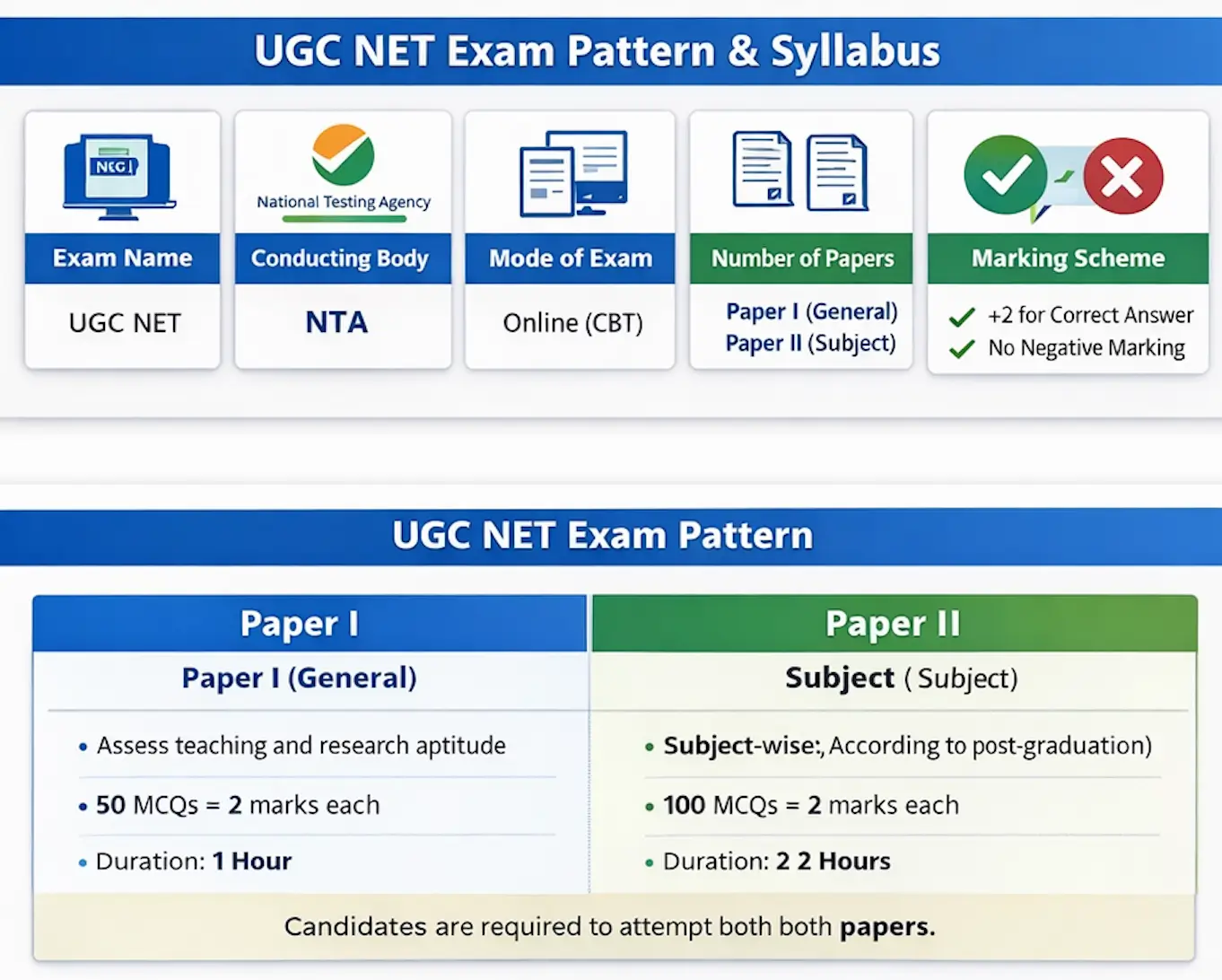
UGC NET Exam Structure and Pattern
The UGC NET 2026 examination will be administered as a Computer-Based Test (CBT). Before diving into the subject-specific curricula, candidates should familiarize themselves with the updated UGC NET Exam Pattern 2026 outlined in the sections below.
| Paper | Pattern of Paper | No. Questions | Marks | Duration |
| Paper-I | The questions will be generic in nature, intending to assess the teaching/research aptitude of the candidate. | 50 | 100 | 03 hours (180 minutes) |
| Paper-II | This is based on the subject selected by the candidate and will assess domain knowledge. | 100 | 200 | |
| Total | 150 | 300 | ||
Key Exam Highlights:
- For each correct answer, the candidate will get 2 marks in both papers 1 & 2.
- There is no negative marking for incorrect answers in the UGC NET 2026 exam.
- No marks will be given for questions Unanswered/Marked for Review.
- All questions are mandatory.
- If a question is found to be incorrect/ambiguous during the key challenge, the candidate who has attempted the question and chosen one of the correct answers will be given credit. If there is any dropped question(s), marks will be awarded to all the candidates.
UGC NET Paper 1 Syllabus 2026
A strategic approach begins with a deep understanding of the UGC NET Paper 1 Syllabus 2026. Because the 2026 exam comprises two distinct papers, we have detailed the core requirements for both to help you structure your revision effectively.
The UGC NET Paper 1 syllabus is designed to evaluate a candidate's teaching aptitude, research methodology, cognitive skills, and awareness of the higher education landscape. Paper 1 contains 50 questions worth 100 marks. You can find the detailed syllabus breakdown and PDF downloads below:
| UGC NET Paper 1 Syllabus 2026 | |
| Unit-I: Teaching Aptitude |
|
| Unit-II: Research Aptitude |
|
| Unit-III Comprehension |
|
| Unit-IV: Communication |
|
| Unit-V: Mathematical Reasoning and Aptitude |
|
| Unit-VI: Logical Reasoning |
|
| Unit-VII: Data Interpretation |
|
| Unit-VIII: Information and Communication Technology (ICT) |
|
| Unit-IX: People, Development and Environment |
|
| Unit-X: Higher Education System |
|
NOTE: (i) Each module carries five questions, totaling 10 marks per section.
(ii) To ensure accessibility, visually impaired candidates will be provided with alternative text-based passages to replace graphical or pictorial questions.
Download the official UGC NET Paper 1 Syllabus PDF in both Hindi and English below.
Download UGC NET Paper 1 Syllabus 2026 PDF [English]
Download UGC NET Paper 1 Syllabus 2026 PDF [Hindi]
UGC NET Paper 2 Syllabus 2026
UGC NET Paper 2 is based on your specific subject expertise. It features 100 objective-type questions carrying a total of 200 marks. With 83 subjects available, candidates are expected to choose their primary post-graduation subject. Access the comprehensive syllabus PDFs for all subjects in the links below.
| UGC NET Paper 2 Syllabus 2026 | |||
| Subject Code | Subjects | Syllabus [in English] | Syllabus [in Hindi] |
| 01 | Economics / Rural Economics /Co-operation / Demography / Development Planning/ Development Studies / Econometrics/ Applied Economics/ Development Eco./Business Economics | Download | Download |
| 02 | Political Science | Download | Download |
| 03 | Philosophy | Download | Download |
| 04 | Psychology | Download | Download |
| 05 | Sociology | Download | Download |
| 06 | History | Download | Download |
| 07 | Anthropology | Download | Download |
| 08 | Commerce | Download | Download |
| 09 | Education | Download | Download |
| 10 | Social Work | Download | Download |
| 11 | Defence and Strategic Studies | Download | Download |
| 12 | Home Science | Download | Download |
| 14 | Public Administration | Download | Download |
| 15 | Population Studies | Download | Download |
| 16 | Music | Download | Download |
| 17 | Management (including Business Admn. Mgt./ Marketing/ Marketing Mgt./ Industrial Relations and Personnel Mgt./ Personnel Mgt./Financial Mgt./ Co-operative Management) | Download | Download |
| 18 | Maithili | Download | Download |
| 19 | Bengali | Download | Download |
| 20 | Hindi | Download | |
| 21 | Kannada | Download | Download |
| 22 | Malayalam | Download | Download |
| 23 | Oriya | Download | Download |
| 24 | Punjabi | Download | Download |
| 25 | Sanskrit | Download | Download |
| 26 | Tamil | Download | Download |
| 27 | Telugu | Download | Download |
| 28 | Urdu | Download | Download |
| 29 | Arabic | Download | Download |
| 30 | English | Download | Download |
| 31 | Linguistics | Download | Download |
| 32 | Chinese | Download | Download |
| 33 | Dogri | Download | Download |
| 34 | Nepali | Download | Download |
| 35 | Manipuri | Download | Download |
| 36 | Assamese | Download | Download |
| 37 | Gujarati | Download | Download |
| 38 | Marathi | Download | Download |
| 39 | French (French Version) | Download | Download |
| 40 | Spanish | Download | Download |
| 41 | Russian | Download | Download |
| 42 | Persian | Download | Download |
| 43 | Rajasthani | Download | Download |
| 44 | German | Download | Download |
| 45 | Japanese | Download | Download |
| 46 | Adult Education/ Continuing Education/ Andragogy/ Non Formal Education. | Download | Download |
| 47 | Physical Education | Download | Download |
| 49 | Arab Culture and Islamic Studies | Download | Download |
| 50 | Indian Culture | Download | Download |
| 55 | Labour Welfare/Personnel Management/ Industrial Relations/ Labour and Social Welfare/ Human Resource Management | Download | Download |
| 58 | Law | Download | Download |
| 59 | Library and Information Science | Download | Download |
| 60 | Buddhist, Jaina, Gandhian and Peace Studies | Download | Download |
| 62 | Comparative Study of Religions | Download | Download |
| 63 | Mass Communication and Journalism | Download | Download |
| 65 | Performing Art - Dance/Drama/Theatre | Download | Download |
| 66 | Museology & Conservation | Download | Download |
| 67 | Archaeology | Download | Download |
| 68 | Criminology | Download | Download |
| 70 | Tribal and Regional Language/Literature | Download | Download |
| 71 | Folk Literature | Download | Download |
| 72 | Comparative Literature | Download | Download |
| 73 | Sanskrit traditional subjects (including) Jyotisha/ Sidhanta Jyotish/ Navya Vyakarna/ Vyakarna/ Mimansa/ Navya Nyaya/ Sankhya Yoga/ Tulanatmaka Darsan/ Shukla Yajurveda/ Madhav Vedant/ Dharmasasta/ Sahitya/ Puranotihasa /Agama). | Download | |
| 74 | Women Studies | Download | Download |
| 79 | Visual Art (including Drawing & Painting/ Sculpture Graphics/Applied Art/History of Art) | Download | Download |
| 80 | Geography | Download | Download |
| 81 | Social Medicine & Community Health | Download | Download |
| 82 | Forensic Science | Download | Download |
| 83 | Pali | Download | Download |
| 84 | Kashmiri | Download | Download |
| 85 | Konkani | Download | Download |
| 87 | Computer Science and Applications | Download | Download |
| 88 | Electronic Science | Download | |
| 89 | Environmental Sciences | Download | |
| 90 | Politics including International Relations/ International Studies including Defence/ Strategic Studies, West Asian Studies, South East Asian Studies, African Studies, South Asian Studies, Soviet Studies, American Studies. | Download | Download |
| 91 | Prakrit | Download | Download |
| 92 | Human Rights and Duties | Download | Download |
| 93 | Tourism Administration and Management. | Download | Download |
| 94 | Bodo | Download | |
| 95 | Santali | Download | |
| 100 | Yoga | Download | Download |
| 101 | Sindhi | Download | Download |
| 102 | Hindu Studies | Download | Download |
| 103 | Indian Knowledge System | Download | Download |
FAQs
Ans: The UGC NET 2026 exam consists of two papers (Paper I & II), with detailed syllabi provided throughout this article.
As of the latest update, there have been no official changes announced for the UGC NET 2026 syllabus.
Ans: No, there is no negative marking for incorrect answers in the UGC NET examination.
The UGC NET 2026 exam will be held in a digital format as a Computer-Based Test (CBT).
Recommended Reads
- UGC NET 2026 Exam Date: June Schedule and Official Notification Details
- UGC NET June Admit Card 2026 Released @ugcnet.nta.ac.in | Download Hall Ticket Link
- UGC NET June 2026 Exam Date Announced: Check Full Schedule and Updates
- UGC NET 2026 Application Deadline Extended to May 23 – Apply Now
- UGC NET June 2026 Notification Released: Key Dates & Application Details
- UGC NET City Intimation Slip 2026 Released: Check Your Exam City at ugcnet.nta.nic.in
Never miss another exam update!
Get the fastest exam results, recruitment news, and educational guides delivered directly to your phone.