Understanding the geometry of round shapes begins with mastering core circle fundamentals. A circle is a closed plane figure defined as the locus of all points that remain at a fixed distance from a central point. The fundamental properties, boundaries, and internal spaces of a circle govern many advanced concepts in mathematics.
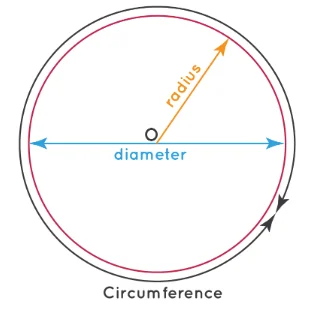
Core Geometric Elements of a Circle
To analyze a circle accurately, you must recognize its primary dimensions:
- Radius: The segment connecting the center to any point on the boundary, represented by 'r' or 'R'.
- Diameter: A line segment that passes directly through the center, connecting two opposite points on the circle's edge, denoted by 'd' or 'D'. The diameter of a circle is always twice its radius (Diameter = 2 × Radius = 2r).
- Circumference: The perimeter of a circle, calculated using the standard circumference of a circle formula C = 2πr.
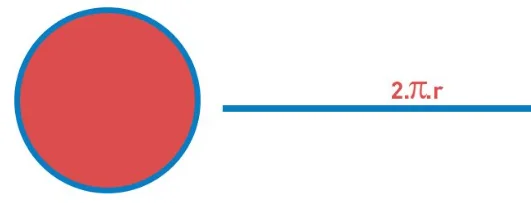
Understanding Pi (π) and Area Concepts
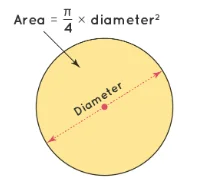
Pi (π) is a mathematical constant defined as the ratio of a circle's circumference to its diameter, approximately equal to 22 / 7 or 3.14. The area of a circle represents the total two-dimensional space or region enclosed within its boundary, expressed in square units (e.g., m² or cm²). The standard area of a circle formula is A = πr² or πd² / 4.
Area of a Circle Formulas Checklist
- If the radius of a circle is given: πr²
- If the diameter of a circle is given: πd²/4
- If the circumference of a circle is given: C²/4π
| Condition | Formula |
|---|---|
| If the radius of a circle is given in the question, then the area is | πr² |
| If the diameter of a circle is given in the question, then the area is | πd²/4 |
| If the circumference of a circle is given in the question, then the area is | C²/4π |
Geometric Decompositions and Derivations
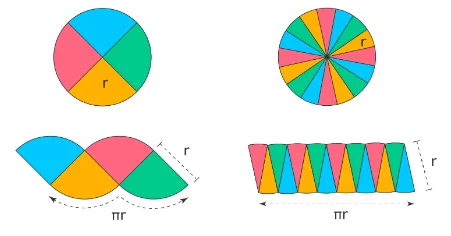
Geometrically, a circle can be decomposed into small sectors and rearranged to approximate a rectangle where length is half the circumference and breadth is the radius. This intuitive proof helps clarify why the area equation functions the way it does.
Practical Solved Examples
Review these practical solved examples to see how the formulas are applied in real-world scenarios:
- Solved example 1: A circular wheel with a radius of 12 cm has an area of 452.16 square cm.
- Solved example 2: If the ratio of the areas of two circular coins is 16:25, the ratio of their radii is 4:5.
- Solved example 3: A circular swimming pool with an inner radius of 25 m and outer radius of 32 m has a surface area of 1254 square meters.
- Solved example 4: An equilateral triangle cable with side lengths of 9 inches bent into a circle yields a circle area of approximately 58.05 square inches.
- Solved example 5: A clock's minute hand of 7 units long travels a distance of 22 units from 3:00 PM to 3:30 PM.
Related Articles
| Types of Triangles | Area of Square |
| Area of Rectangle | Area of Triangle |
| Area of Equilateral Triangle | Area of Trapezium |
Frequently Asked Questions (FAQs)
Recommended Reads
- Mastering Triangle Geometry: Formulas, Calculations, and Classifications
- How to Calculate the Area of a Square: Formulas, Examples, and Geometry Guide
- Mastering the Area of a Parallelogram: Formulas, Properties & Solved Examples
- Understanding Rectangle Properties, Formulas, Area & Calculations
- Mastering the Trapezium: Area, Perimeter, Formulas & Solved Problems
- Complete Educational Guide to the Area of an Equilateral Triangle
Exam Photo & Signature Resizer (20KB - 50KB)
Resize passport photo & signature to 20-50KB with Name & Date of Photo (DOP) strip or combine them in 1-click.
Never miss another exam update!
Get the fastest exam results, recruitment news, and educational guides delivered directly to your phone.