A square is one of the most fundamental shapes in geometry. Defined as a two-dimensional plane shape with four equal sides and four 90-degree internal angles, it is a specific type of quadrilateral where all sides are parallel to one another. Understanding the surface space it occupies is a key skill in mathematics.
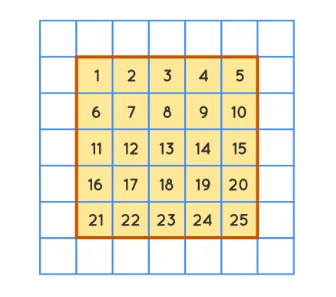
Defining the Area of a Square
The area of a square represents the total surface space covered within its boundaries. In scientific terms, this is expressed in square units, such as square meters (m²) or square centimeters (cm²). From chessboards and tiles to napkins and stamps, squares are found throughout our daily lives.
Core Mathematical Formulas
To calculate the area of a square, you can use two primary methods depending on the information you have available.
1. Using the Side Length
The standard formula is to multiply the length of one side by itself: Area = Side × Side = a², where 'a' represents the length of the side.
- Example: A square plot with a side length of 12 m has an area of 144 m².
- Example: A square cushion with a side length of 9 cm has an area of 81 cm².
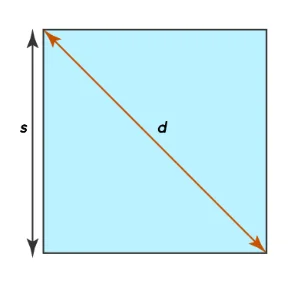
2. Using the Diagonal
If the side length is unknown, you can use the diagonal (d). The relationship between the diagonal and side length is derived from the Pythagorean theorem (d = √2s). This leads to the formula: Area = d²/2.
- Example: A square floor with a diagonal of 11 m results in an area of 60.5 m².
- Example: A square stamp with a diagonal of 1.5 cm results in an area of 1.125 cm².
- Example: A chessboard with an area of 1600 cm² allows us to determine the side length is 40 cm.
Frequently Asked Questions (FAQs)
Recommended Reads
- Mastering Triangle Geometry: Formulas, Calculations, and Classifications
- Mastering the Area of a Parallelogram: Formulas, Properties & Solved Examples
- Understanding Rectangle Properties, Formulas, Area & Calculations
- Mastering the Trapezium: Area, Perimeter, Formulas & Solved Problems
- Complete Educational Guide to the Area of an Equilateral Triangle
- Mastering Circle Fundamentals, Area Formulas, and Geometry Derivations
Exam Photo & Signature Resizer (20KB - 50KB)
Resize passport photo & signature to 20-50KB with Name & Date of Photo (DOP) strip or combine them in 1-click.
Never miss another exam update!
Get the fastest exam results, recruitment news, and educational guides delivered directly to your phone.