Geometry is filled with fundamental shapes, but few are as ubiquitous and practical as the rectangle. Whether in architecture, design, or mathematics, mastering the mechanics of this shape is essential. This guide breaks down everything you need to know about the properties, mathematical formulas, and calculations surrounding rectangles.
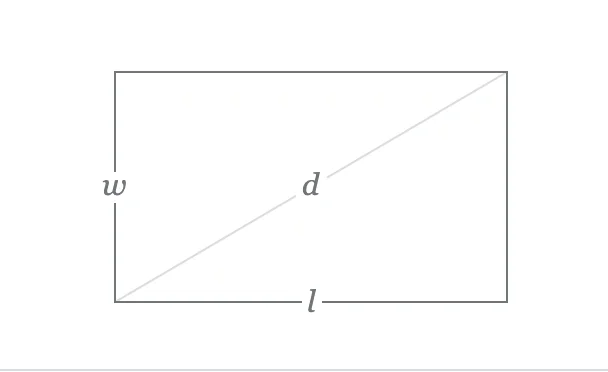
Core Properties of a Rectangle
A rectangle is classified under a specific category of two-dimensional shapes. Below is a detailed checklist of its defining characteristics:
- A rectangle is a kind of quadrilateral-shaped figure.
- The opposite sides of a rectangle are similar in length and parallel to one another.
- The four interior angles of a rectangle have values of 90° at each vertex.
- The addition of all four interior angles of a rectangle results in 360° (90°+90°+90°+90°).
- The rectangle diagonals bisect one another.
- The two diagonals of a rectangle are the same in terms of their length.
- The diagonal length can be calculated by using the Pythagoras Theorem. If the diagonal length with sides a and b then the length of the diagonal is = √( a² + b²).
- When all four sides of a rectangle are parallel in nature then it is called a parallelogram.
- It is to be noted here that all rectangles are considered parallelograms surely but all parallelograms can not be called rectangles.
Mathematical Formulas and Area Calculations
The area of a rectangle is defined as the total region enclosed by its four sides on a 2-dimensional plane. Standard calculations rely on length and width, but you can also determine area using diagonal measurements.
Here are the standard formulas:
- Standard Area Formula: Area = Length × Breadth (A = L × B), expressed in square units.
- Area Using Diagonal and Length: Length × √(Diagonal)² – (Length)²
- Area Using Diagonal and Width: √(Diagonal)² – (Width)² × Width
Understanding Diagonals and Triangles
The diagonals of a rectangle play a critical role in structural geometry. When drawn, they bisect the shape into two congruent right-angled triangles. Because opposite sides and internal right angles establish strict symmetry, both diagonals share identical lengths and can be easily evaluated using the Pythagorean Theorem (√(a² + b²)) referenced in shape analysis like figure ABCD.
Frequently Asked Questions (FAQs)
Recommended Reads
- Mastering Triangle Geometry: Formulas, Calculations, and Classifications
- How to Calculate the Area of a Square: Formulas, Examples, and Geometry Guide
- Mastering the Area of a Parallelogram: Formulas, Properties & Solved Examples
- Mastering the Trapezium: Area, Perimeter, Formulas & Solved Problems
- Complete Educational Guide to the Area of an Equilateral Triangle
- Mastering Circle Fundamentals, Area Formulas, and Geometry Derivations
Exam Photo & Signature Resizer (20KB - 50KB)
Resize passport photo & signature to 20-50KB with Name & Date of Photo (DOP) strip or combine them in 1-click.
Never miss another exam update!
Get the fastest exam results, recruitment news, and educational guides delivered directly to your phone.